
Political stability in Morocco: when perception does not match reality
There is a concern that frequently comes up in my conversations with European executives who are considering Morocco as a destination for expansion. It often arises after we have discussed industrial opportunities, talent, geographical proximity or global competitiveness.
“But is Morocco really politically stable?”
It’s a legitimate question. Stability is an essential pillar for making strategic decisions, especially when it comes to a decision as bold as expanding outside the EU.
What strikes me is how this perception, so widespread in Spain, contrasts with the reality experienced every day by foreign companies already established in the country and continuing to grow, including GRUPO BARCELO, ALSA and RENAULT. Morocco is, in fact, one of the most stable and predictable countries in the Mediterranean.
Stability built on consistency over more than 20 years
Morocco’s stability stems from political and economic continuity that has been maintained for over two decades. Under the leadership of His Majesty King Mohammed VI, the country has pursued a long-term development strategy, the results of which are beginning to take visible shape across all sectors, positioning Morocco as a regional leader.
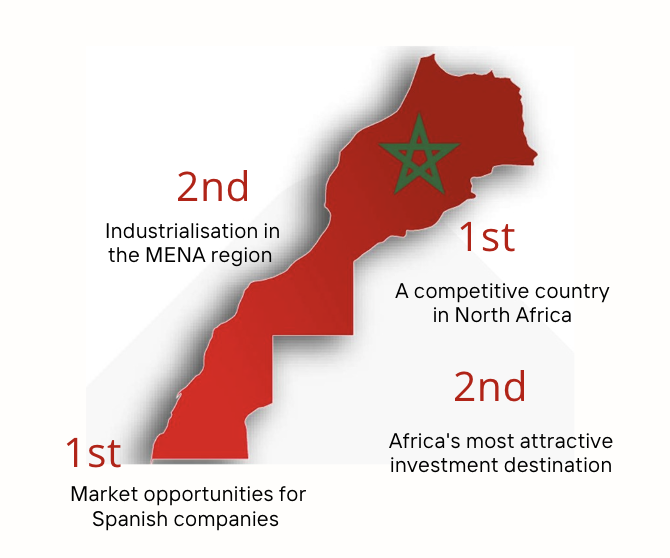
Source: AMDIE
This vision, set out in the “New Development Plan”, is being realised through national projects that are reshaping the Moroccan economy. For example, the Maroc Digital 2030 initiative is accelerating administrative and business modernisation, whilst the Maroc Vert Plan has transformed the agricultural sector and its international standing. Added to this are the Vision 2030 initiatives for Education and Tourism, which incorporate far-reaching reforms. All these initiatives share a common purpose: a sustained commitment to long-term development backed by significant and transparent public investment, clearly detailed in the Finance Act, where budgets are approved annually.
STRUCTURAL GROWTH
Morocco has undergone profound changes over the last twenty years. This has not been a fleeting period of growth, but the result of consistent leadership and sustained efforts.
Those of us who have witnessed this evolution from within know
This is not a matter of perception but of facts backed up by data. GDP has tripled, rising from around €54 billion in 2005 to approximately €170 billion in 2024. The IMF forecasts growth of 4% for 2025, a figure that stands out against an international backdrop marked by geopolitical tensions, global inflation and uncertainty.
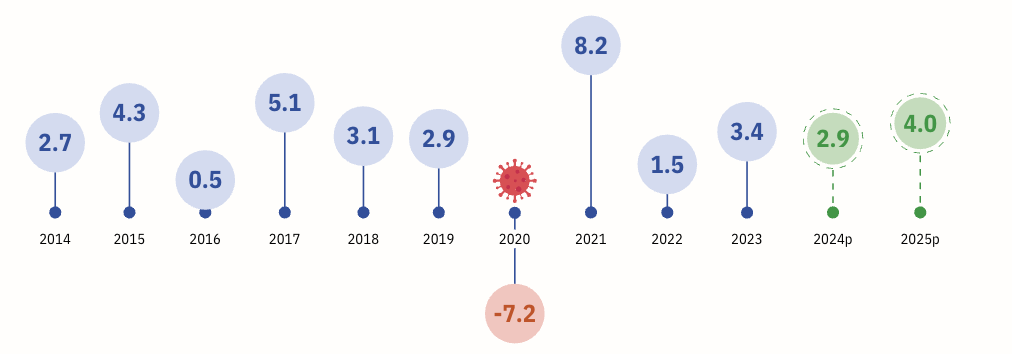
Figure 1: Morocco – Gross Domestic Product (GDP) growth, 2014–2025 (forecast). Source: International Monetary Fund
Political stability is reflected in very sound macroeconomic fundamentals, with steady structural progress year on year
According to the World Bank, inflation in Morocco averaged just 1.8% per annum between 2005 and 2025, well below the global average
The Moroccan dirham remains stable and under control, supported by a prudent monetary policy
Morocco ranks 53rd out of 190 countries worldwide in the World Bank’s “Doing Business 2020” index, first in the Maghreb and third in Africa.
Foreign direct investment rose by more than 30% in 2024, exceeding €3.6 billion for the year – a record high for the country!
These results confirm Morocco’s stability, transparency and economic appeal
Morocco’s economic progress since 2005 has been driven by industrial diversification in the automotive, aeronautics, agri-food, textile and pharmaceutical sectors, the development of infrastructure, services and tourism, alongside steady growth in foreign direct investment.
And all this is possible, to a large extent, thanks to the political stability maintained under the leadership of His Majesty King Mohammed VI and the effective functioning of state institutions.
What this stability means for European multinationals
For any executive responsible for international development, these indicators enable an assessment of the risk and viability of international expansion outside the EU.
The sustained growth of Morocco’s GDP points to an expanding economy capable of absorbing industrial investment and sustaining strategic projects, underpinned by a growing market and rising demand.
Low and controlled inflation means less pressure on costs and greater ability to protect margins.
The stability of the dirham provides financial visibility and limits exchange rate risk in purchases, contracts or the repatriation of profits.
A regulatory framework that is well positioned internationally.
In a leading ranking such as Doing Business, this reflects the country’s progress in streamlining administrative procedures, providing legal protection and offering incentives for foreign investment.
Furthermore, the sharp rise in foreign direct investment is perhaps the most telling indicator. When international investment accelerates in this way, it is a SIGN of collective confidence.
The question is no longer whether Morocco is a politically stable country, but how to position my company as soon as possible to capitalise on the current growth and gain a lasting competitive advantage on a global scale.
Companies do not invest billions without assessing risks, returns and stability. The growing inflow of foreign capital indicates that other global players have already identified a clear opportunity and decided to get ahead of the curve.
More and more companies are including Morocco in their international roadmap because they understand that it offers them stability and growth potential.
At LAOLA INVEST, we understand the challenge and complexity of establishing a presence in a new market such as Morocco. We support you in your internationalisation strategy in a secure, agile and profitable manner.
Let’s talk!